Aorus M5 Honest Review — Is the Hype Justified?
I've been using the Aorus M5 as my daily driver for several months now—both for work and for gaming—and I wanted to share a straightforward, no-fluff account of what I actually experienced. I bought this mouse because the marketing promised a balance of high performance and comfort without the compromises I usually see in ultra-light mice. After hundreds of hours of use, I can tell you what held up, what disappointed me, and whether the hype is really justified for most people.
Quick summary (for skimmers)
In my experience, the Aorus M5 nails the basics: reliable wireless, accurate tracking, and a comfortable ergonomic shape that works well for claw and palm grips. Where it falters is in its software polish and some small but persistent design choices that affected my day-to-day comfort. If you want a solid wireless mouse that feels like a premium, usable tool rather than an experiment in minimalism, the Aorus M5 is worth considering. If you chase the absolute lightest weight or flawless software ecosystems, you might feel mixed.
What I tested and how
I used the Aorus M5 for about four months at home and during travel. My usage pattern included:
- Daily office work (web browsing, text editing, spreadsheets)
- Competitive and casual gaming sessions across FPS and strategy games
- Long recording/editing sessions where I had it on for many hours a day
- Testing wireless stability in busy Wi‑Fi/2.4 GHz environments
During that time I switched grips (palm vs claw), changed DPI and polling settings, and ran it with RGB on and off to feel practical battery life. I also spent time with the Aorus configuration software to tweak buttons and lighting.
Design and build: what it feels like daily
When I first picked up the Aorus M5, the most striking thing was its approachable ergonomic shape. The shell has a gentle slope and a slightly raised hump that fits a broad range of hand sizes comfortably. I'm right-handed and typically alternate between a relaxed palm grip and a higher claw grip; the M5 supported both without feeling awkward.
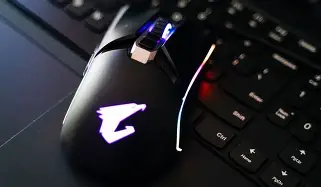
The top finish feels matte and pleasantly grippy, so the mouse stays planted under my hand instead of sliding around when my palms get warm. I appreciated the textured side grips—small ridges that help keep my thumb and ring finger steady during fast movements. The button layout is conventional: two main buttons, two side buttons positioned above the thumb rest, DPI switch behind the scroll wheel, and an easy-to-reach profile button. I found the side buttons to be reachable without needing to adjust my grip much, but they are placed a bit higher than I personally prefer. That meant a couple of accidental presses until I adapted.
Build quality felt solid. There is a satisfying click to the main buttons (not too spongy, not overly stiff). The scroll wheel offers a tactile, precise click per notch for me; I didn't notice any wobble even after several months. There was a small cosmetic issue that bothered me: the micro-USB/USB-C charging port (depending on the unit you get) sits at the front and the cable protrudes slightly when plugged in, which made it less elegant when I wanted to use it in wired mode during long charging sessions. It didn't affect function, but I noticed it every time I plugged the cable in.
Performance: sensor, tracking and latency
In actual use, the Aorus M5 felt rock-solid. Tracking was consistent across my mousepad surfaces; I didn't experience jitter, skipped frames, or strange acceleration. In fast twitch scenarios during FPS matches, the cursor followed my motions predictably. I tend to use a moderate DPI for aiming—around 1200–1600 depending on the game—and the M5 delivered the precision I wanted without needing overcomplicated tuning.
Wireless performance was one of the reasons I bought the M5, and I was pleasantly surprised. Over several weeks of testing in crowded 2.4 GHz environments—coffee shops, apartments with many neighbors, and a wireless-heavy office—the connection remained stable. I had no noticeable input lag compared to wired mice in my experience, and there were no random dropouts. That said, I always keep the dongle in a front USB port or on a small extension; when I put the dongle behind a thick laptop casing, I experienced slightly higher latency like any other 2.4 GHz mouse.
Shop the latest Electronics picks on Amazon.
Browse Now →Battery life and charging
I tested battery life with RGB lighting on medium brightness and with it disabled. With lighting on, I consistently got a couple of days of heavy mixed use (long workdays plus gaming). With lighting off and conservative DPI/polling settings, the battery stretched to several days to a week. Those numbers will vary depending on your usage, but in my day-to-day use I didn't feel crippled by short battery life. Recharging is straightforward, but as I mentioned the charging cable sticks out a bit when plugged in, and the mouse doesn't sit perfectly flat with the cable attached—again, not a deal-breaker but a minor annoyance.
Software: customization and quirks
The Aorus configuration software offers the expected features: button remapping, DPI presets, polling rate adjustments, and RGB control. What I liked was that the basics are all accessible and logical. What I didn't love was the occasional sluggishness and an interface that felt less polished than some competitors' ecosystems. I experienced one or two times where the software didn't instantly apply a DPI change until I reopened the profile, and I had to tinker a bit to have settings reliably sync to the mouse's onboard memory. On the plus side, once set, the mouse retained profiles as expected when moving between machines.
Ergonomics and real-world comfort
Comfort is where the Aorus M5 mostly excels for me. Extended editing sessions of several hours produced minimal fatigue compared to other full-sized mice I've used. The thumb rest is broad enough that I didn't feel my thumb hanging in midair. One thing that bothered me after long nights of use: the side buttons press area is slightly raised, and if you rest your thumb on that zone you will sometimes register an input. After a few days I simply formed a light habit of keeping my thumb a hair lower, and the issue mostly went away.
Longevity and day-to-day reliability
After months, the mouse still looks and behaves like new. The finish did not discolor or peel in spots where my hand rests, and the primary clicks held their responsive feel. If you're the type who tends to be hard on gear, I would still suggest keeping the mouse in a pouch while traveling because the exposed side buttons and glossy profile touches can pick up scuffs if tossed in a bag with other objects.
Pros & Cons
- Pros:
- Comfortable, ergonomic shape that suits both palm and claw grips
- Solid wireless performance with very few dropouts in real-world environments
- Accurate and consistent tracking for both work and competitive gaming
- Good battery life in daily mixed-use scenarios
- Clean, understated design with useful RGB customization
- Cons:
- Software could be more polished; occasional sync quirks
- Side button placement led to accidental presses until I adapted
- Charging cable protrudes and feels awkward when plugged in for wired use
- Not the lightest mouse on the market—ultra-light fans may prefer other models
Comparison: How the Aorus M5 stacks up
Below is a practical comparison based on my experience and intended use—rather than a specs-only list—against two popular alternatives I used or tested alongside the M5.
| Model | Weight (feel) | Main advantage | Best for |
|---|---|---|---|
| Aorus M5 | Moderately light—balanced between comfort and agility | Comfortable ergonomics and stable wireless in busy environments | Users who want reliable wireless and comfort for long sessions |
| Logitech G Pro X Superlight | Very light—designed for speed | Extremely low weight and excellent sensor performance | Esports players and motion-heavy FPS gamers who prioritize minimal weight |
| Razer DeathAdder (series) | Heavier—classic full-size feel | Large, comfortable palm grip and simple, proven design | Users who prefer a larger, stable grip and don't chase ultra-light builds |
From my perspective, the Aorus M5 sits comfortably in the middle: lighter and more agile than classic larger mice but not an ultra-light specialist. It tries to balance comfort and competitive performance, and it succeeds if that balance is what you want.
Who should buy the Aorus M5?
In my experience, the Aorus M5 is a good fit if you:
- Want a wireless mouse that feels reliable and responsive without fuss
- Value comfort for long productivity sessions as much as gaming performance
- Prefer a shape that accommodates both palm and claw grips
- Don't need the absolute lightest possible mouse or the smoothest third-party software
It might be less suitable if you:
- Prioritize every gram of weight reduction for competitive twitch play
- Expect a flawless, ultra-polished software ecosystem with frequent updates and immediate syncs
- Have very small hands and prefer smaller ambidextrous shapes
Buying guide: what to look for and how I chose
When I chose the Aorus M5, I had a few personal requirements that guided me, and you can use these questions to decide if it's right for you:
Discover deals on Electronics — updated daily.
View Offers →1. What grip do you use?
I switched grips during testing and found the M5 adaptable, but if you have a very small hand and use fingertip grip exclusively, try to get a feel for the shape in person. For palm and claw users, the shape will likely fit well.
2. Do you travel with your mouse?
If you toss your mouse into a backpack, consider that the M5's side buttons and finish are durable but could pick up scuffs. A travel pouch helps. Also, keep in mind the dongle—if you lose that, wireless becomes inconvenient; I recommend storing the dongle in the mouse's onboard compartment (if your unit includes one) or in a small case.
3. How important is software stability?
I wanted stable onboard memory so I could move the mouse between systems. The M5 mostly delivered, though I had to occasionally reapply settings through the software. If you depend on instant cloud-synced profiles across many machines, be prepared for some manual steps.
4. Battery expectations
Decide whether you want RGB on all the time. I turned RGB off during long workdays and kept it on for gaming sessions. That gave me a better mix of battery life and aesthetics. If battery endurance is the top priority, consider the settings and polling rate: dialing these down extends life considerably.
5. Test the side buttons
If possible, test the side button placement. I initially struggled with accidental presses until I adjusted my thumb position. For some people this might never be an issue; for others it could be annoying.
Final thoughts and conclusion
After several months with the Aorus M5, I can say that the hype mostly lines up with how the mouse performs day-to-day. What I found was a very well-rounded device that balances comfort, accurate tracking, and dependable wireless performance without pushing into extremes. It doesn't win every category—its software could be better and it isn't the lightest mouse out there—but for someone like me who values a dependable, comfortable mouse for long working days and competitive gaming, the Aorus M5 was a satisfying purchase.
In short: If you're looking for a reliable wireless mouse that won't frustrate you during long sessions and still performs well in games, the Aorus M5 is definitely worth considering. If you need the last ounce of weight savings or the most polished software experience, you might find better fits elsewhere. For my use case, the M5 hit the sweet spot more often than not, and I kept using it long after the initial review period ended.